

When it comes to customer experience, the acronyms B2B (Business-to-Business) and B2C (Business-to-Consumer) represent more than just who signs the check.
They dictate the speed of your communication, the complexity of your problem-solving, and the very foundation of your customer relationships.
While the ultimate goal of any service team is to provide a helpful, human experience, the strategy used to get there varies widely by audience.
This guide explores the fundamental differences between B2B and B2C customer service and how to optimize your approach for each.
Understanding the Core: What Defines B2B and B2C Customer Support?
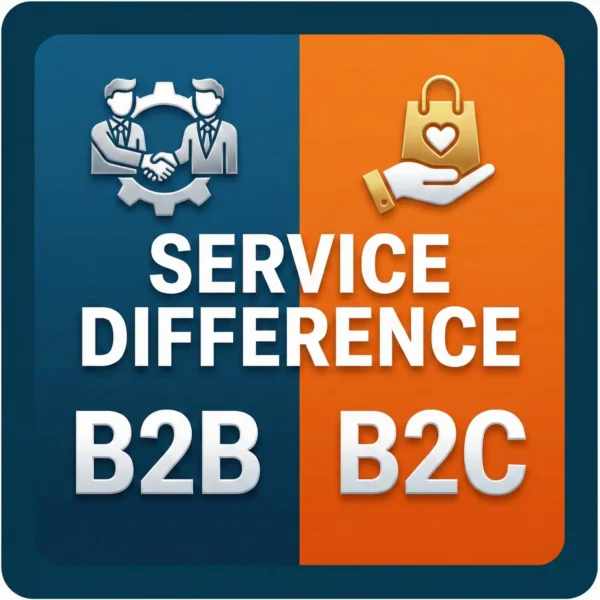
At its simplest, B2C customer service is focused on the individual. The interactions are usually high-volume, low-complexity, and focused on immediate resolution. Think of a retail shopper asking about a return policy or a streaming service subscriber reporting a login issue.
B2B customer service, conversely, involves supporting a business entity. These interactions are lower in volume but significantly more complex. You aren’t just helping “a person”; you are helping a stakeholder manage a tool or service that their entire company relies on.
The Big Picture: 5 Critical Differences Between B2B and B2C Service
To master your service strategy, you must understand these five key points of divergence.
1. Audience Complexity: Individual Needs vs. Stakeholder Consensus
In B2C, you deal with one person. If they are happy, the ‘account’ is happy. In B2B, the ‘customer’ is often a collection of stakeholders—from the IT manager who implements the software to the CFO who approves the budget to the end users who use it daily. Service teams must navigate these different personas and their varying priorities.
2. Volume vs. Value: Scaling Tickets vs. Cultivating High-Stakes Accounts
B2C brands often deal with thousands of tickets per day. Success is measured by how efficiently you can resolve these at scale. In B2B, a single account might represent 20% of your annual revenue. This requires a ‘white-glove’ approach in which the depth of the relationship outweighs the speed of ticket closure.
3. The Support Lifecycle: Transactional Speed vs. Long-Term Partnership
B2C support is often transactional: a problem arises, it’s fixed, and the interaction ends. B2B support is a continuous lifecycle. Service teams often act as ‘Customer Success’ partners, ensuring clients achieve their business goals over the long term, not in the short term.
4. Emotional Hook vs. Logical ROI: What Drives Satisfaction?
B2C loyalty is often driven by emotion and brand identity. B2B loyalty is driven by logic, efficiency, and Return on Investment (ROI). If a B2B service team can’t demonstrate that its solution saves the client time or money, no amount of “friendly service” will prevent churn.
5. Communication Style: Social Media vs. Dedicated Managers
B2C customers expect to reach you on WhatsApp, X (Twitter), or via a quick chatbot. B2B customers typically prefer more formal, documented channels like email, phone calls with dedicated account managers, or specialized project management portals.
Support Strategies That Work: Tailoring Your Approach
B2C Best Practices: Prioritizing Frictionless Speed
- Invest in Self-Service: Most B2C customers prefer to find the answer themselves. A robust Knowledge Base is essential.
- Leverage AI and Bots: Use AI to handle routine queries (e.g., “Where is my order?”) so humans can focus on more nuanced issues.
- Omnichannel Consistency: Ensure the experience is the same whether the customer reaches out via Instagram or email.
B2B Best Practices: Transitioning from Reactive to Proactive
- Dedicated Support Tiers: Assign high-value accounts a dedicated representative who understands their specific business environment.
- Proactive Check-ins: Don’t wait for the client to report a bug. Reach out with quarterly business reviews (QBRs) to show value.
- Technical Expertise: B2B agents need deep product knowledge. They aren’t just reading from a script; they are acting as consultants.
Bridging the Gap: What B2B and B2C Can Learn From Each Other
The lines are blurring. This is often referred to as the ‘Consumerization of B2B.’ B2B buyers now expect the same ease of use and interface quality they get from B2C brands like Amazon or Netflix.
Conversely, B2C brands are realizing that high-value consumers (like luxury car buyers) appreciate the personalized, ‘B2B-style’ relationship management.
The Tech Stack: Essential Tools for Every Service Model
Choosing the right CRM is the backbone of your service strategy. Here is how priorities shift based on your model:
| Feature | B2C Priority | B2B Priority |
|---|---|---|
| CRM Data | Mass segmentation & purchase history | Complex account hierarchies & contract terms |
| Ticketing | High-volume automation & speed | Escalation paths & internal collaboration |
| Reporting | Response times & CSAT scores | Customer Health Scores & Net Promoter Score (NPS) |
| Integrations | Social media & e-commerce platforms | ERPs, Slack, and project management tools |
Delivering Excellence in a Human-Centric World
Whether you are helping a teenager track a package or helping a Global 500 company migrate its data, the core of great service remains the same: empathy and expertise.
By understanding the specific pressures your customers face—whether those are personal or professional—you can build a service engine that drives long-term growth.