

According to IDC’s 2025 Worldwide Semiannual Software Tracker, which measured the global CRM applications market for 2024, the leading vendors held the following revenue shares:
| Vendor | Market Share (%) |
|---|---|
| Salesforce | 20.7 |
| Microsoft | 5.2 |
| Oracle | 4.0 |
| Adobe | 3.7 |
| SAP | 3.2 |
| HubSpot | ~3.0 |
| Zoho | ~3.0 |
| All Others | 57.2 |
Salesforce continues to lead the CRM market by a wide margin. Its CRM revenue in 2024 exceeded the combined revenue of Microsoft, Oracle, Adobe, and SAP. IDC has now ranked Salesforce the #1 CRM vendor worldwide for 12 consecutive years, including the #1 position in North America.
A Quick Comparison
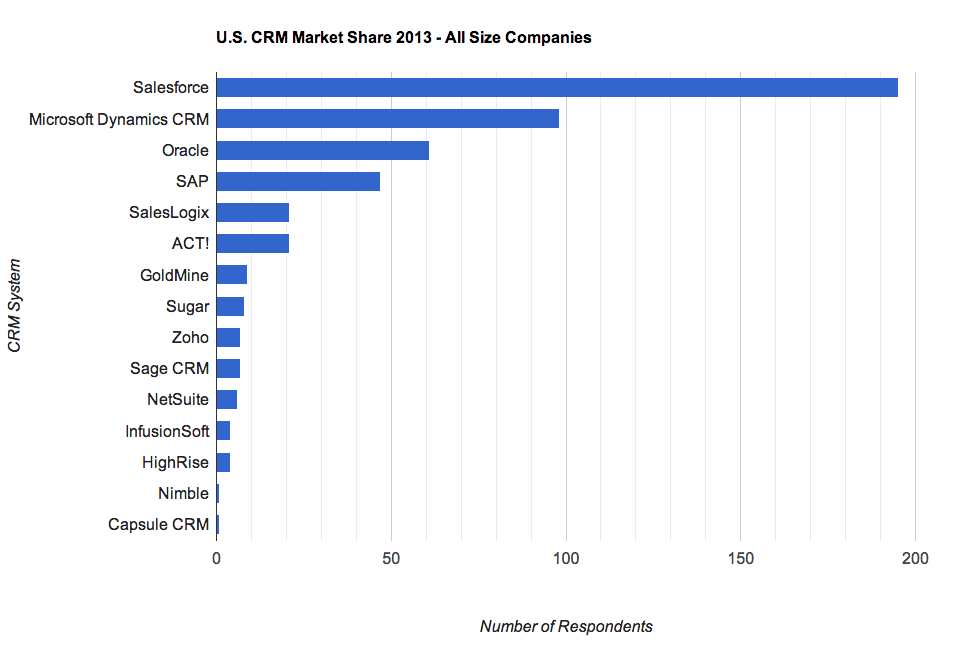
Comparing the latest IDC numbers to the 2021 Statista data we previously reported (and to our original 2013 survey), a few patterns stand out:
- Salesforce’s lead has narrowed slightly — its share dipped from 21.7% in 2023 to 20.7% in 2024, not because Salesforce shrank (CRM revenue grew 9.5%), but because the overall market grew faster, at 12.8%.
- Adobe leapfrogged SAP into the #4 position, fueled by 13.7% CRM revenue growth — the fastest among the top five.
- HubSpot, which didn’t have a CRM offering when we ran our original 2013 survey, has emerged as a serious mid-market force. It now has roughly 290,000 paying customers — nearly twice Salesforce’s reported 150,000+ — though its CRM revenue share still trails the legacy enterprise vendors.
- SugarCRM, ACT!, GoldMine, and SalesLogix — all visible in our 2013 data — have effectively dropped out of the top tier. Most have been absorbed by larger holding companies or have refocused on niche segments.
- The “All Others” segment has grown substantially — from 46% in 2007 to roughly 57% today — reflecting an increasingly fragmented long tail of niche, vertical, and SMB-focused CRM vendors.
Market Size and Growth
The global CRM applications market reached approximately $100 billion in 2024, with North America accounting for the largest share — roughly 32% of global revenue. The U.S. alone is on track to account for over $22 billion in CRM software revenue in 2026.
Most analyst firms project continued double-digit growth through the rest of the decade, driven largely by the integration of generative AI and autonomous agent capabilities into CRM platforms.
AI Is Reshaping the Vendor Landscape
Every major CRM vendor has now embedded AI agents and generative AI features into its core product:
- Salesforce launched Agentforce, its agentic AI layer for deploying autonomous agents across sales, service, and marketing workflows.
- Microsoft integrated Copilot across Dynamics 365, leveraging its tight ties to Microsoft 365, Teams, and Power Platform.
- HubSpot rolled out its Breeze AI architecture, focused on AI-powered agents for lead routing, ticket resolution, and campaign coordination.
- Adobe brought agentic AI to its Customer Experience Cloud through Firefly-based generative tools for marketing personalization.
- Oracle released its AI Agent Studio for context-aware sales, marketing, and service agents.
- SAP tied its Customer Experience suite more tightly to its operational data through agent-driven journey orchestration.
For buyers, this means the evaluation conversation has shifted. CRM purchase decisions in 2026 are increasingly driven by AI capabilities, data unification, and total cost of ownership — not just feature checklists or seat licenses.
What Buyers Should Take Away
Salesforce remains the safe enterprise default, especially for organizations that want the broadest ecosystem and the deepest AppExchange integrations.
Microsoft Dynamics 365 is the natural choice for organizations already standardized on Microsoft 365 and Azure.
HubSpot continues to win mid-market and growth-stage companies on usability, faster implementation, and lower total cost of ownership. Zoho competes aggressively in the SMB segment on price and the breadth of its suite.
The most important shift since our original 2013 survey isn’t who is on top — Salesforce was #1 then and remains #1 now — but how fragmented the rest of the market has become. The “long tail” of CRM vendors now collectively holds more market share than the top five combined, giving buyers significantly more viable options than they had a decade ago.
Note: Market share figures vary across research firms (IDC, Gartner, Statista, and others) depending on how each defines the CRM market. The IDC numbers above include sales force productivity, marketing campaign management, customer service, contact center, advertising, and digital commerce applications.